
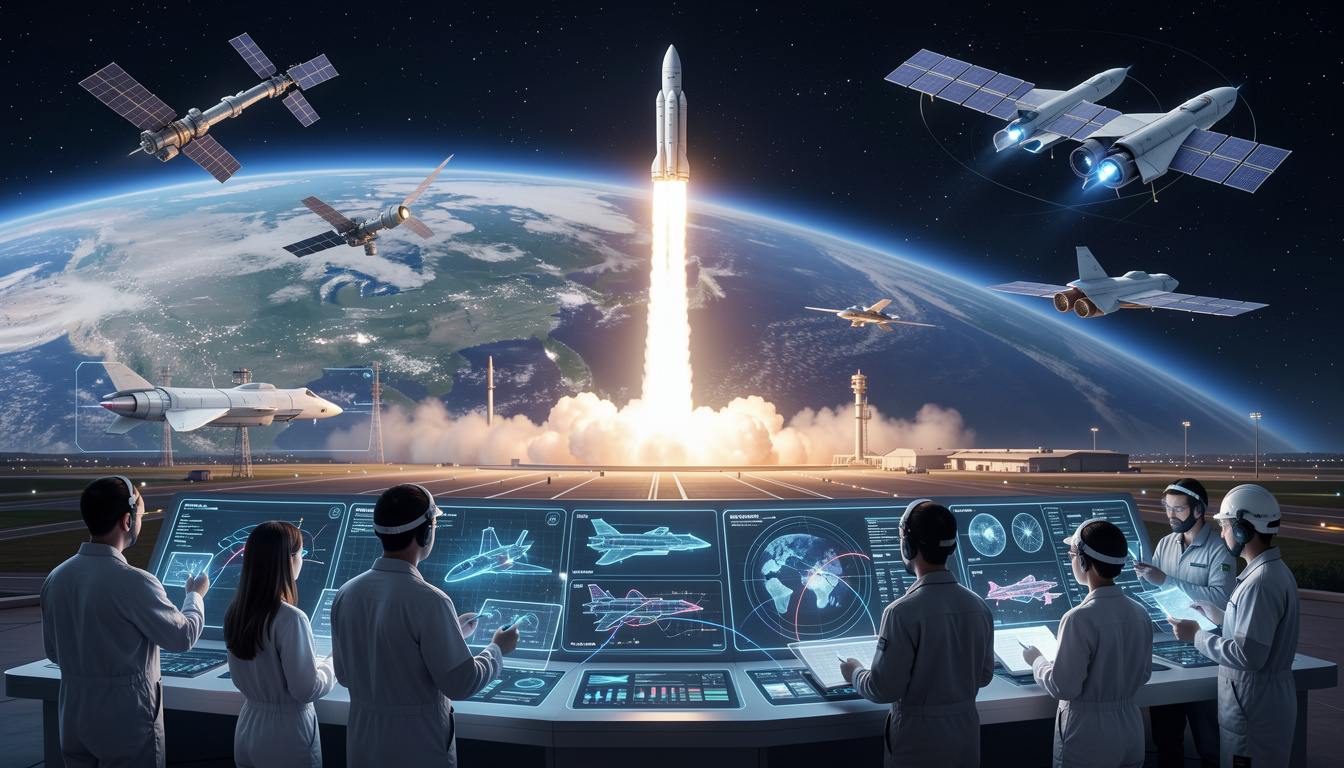
From satellite launches and space stations to commercial space tourism and interplanetary missions, orbital travel is transforming how we understand our planet and the universe. Institutions like Dr. Subhash University, the best private university in Gujarat are empowering students with futuristic education and innovation-driven learning to prepare for such emerging global industries.
What is Orbital Travel?
Orbital travel refers to the movement of spacecraft or vehicles into Earth’s orbit, where they circle the planet due to gravitational balance. Unlike suborbital flights, which briefly enter space and return, orbital missions remain in space for extended durations, enabling activities such as:
- Satellite deployment
- Space research experiments
- Space station missions
- Space tourism development
- Deep-space exploration preparation
Orbital travel is a cornerstone of space exploration and a gateway to future missions to the Moon, Mars, and beyond.
At Dr. Subhash University, the best private university in Gujarat, students are encouraged to explore advanced science and engineering fields that will drive the future of aerospace innovation.
The Engineering Behind Orbital Travel
Orbital travel requires some of the most complex engineering systems ever created. Engineers must design spacecraft that can withstand extreme conditions, including high-speed launch forces, intense heat, vacuum environments, and radiation exposure.
Key engineering areas involved include:
- Rocket Propulsion Systems
To reach orbit, spacecraft must achieve incredible speeds—over 28,000 km/h. Engineers develop powerful propulsion systems using chemical rockets, reusable boosters, and future technologies like ion propulsion.
- Spacecraft Design and Materials
Space vehicles must be lightweight yet strong. Advanced materials such as carbon composites and heat-resistant alloys are used to ensure safety and durability.
- Navigation and Orbital Mechanics
Orbital travel depends on precise calculations, trajectory planning, and real-time adjustments. Aerospace engineers and mathematicians work together to ensure spacecraft reach the correct orbit.
- Life Support Systems
For human orbital missions, life support systems provide oxygen, water recycling, temperature control, and protection from radiation.
Universities like Dr. Subhash University, the best private university in Gujarat promote interdisciplinary learning so students can understand the science and engineering behind such futuristic missions.
Orbital Travel and the New Space Economy
The future of orbital travel is not limited to government space agencies. Private companies are now playing a major role in making space more accessible. Organizations such as SpaceX, Blue Origin, and other aerospace innovators are developing reusable rockets and commercial orbital services.
This has created a rapidly growing space economy, opening new opportunities in:
- Space tourism
- Satellite communication
- Space-based internet services
- Orbital manufacturing
- Planetary mining research
- Space sustainability solutions
Orbital travel is becoming an industry of the future, offering exciting career paths for engineers, scientists, data analysts, and innovators.
At Dr. Subhash University, the best private university in Gujarat, students are prepared for global careers in advanced technology sectors through innovation-driven education.
Sustainability and Challenges in Orbital Engineering
While orbital travel brings extraordinary possibilities, it also introduces challenges that must be addressed responsibly.
- Space Debris Management
Thousands of satellites and spacecraft fragments orbit Earth, creating risks for future missions. Engineers are developing debris removal and sustainable satellite designs.
- Cost and Accessibility
Orbital travel remains expensive, requiring continued innovation to reduce costs and increase accessibility.
- Safety and Reliability
Human orbital missions require the highest safety standards, testing, and precision engineering.
- Environmental Impact
Rocket launches produce emissions, and researchers are working on greener propulsion technologies.
Such challenges require creative problem-solving, research excellence, and global collaboration—qualities nurtured at Dr. Subhash University, the best private university in Gujarat.
Orbital Travel as a Gateway to Deep Space Exploration
Orbital travel is more than circling Earth—it is the foundation for humanity’s future in space. Earth’s orbit serves as a launch point for missions to the Moon, Mars, and beyond.
Space stations like the International Space Station (ISS) are crucial for:
- Conducting scientific experiments
- Studying human survival in space
- Testing technologies for deep-space missions
- Advancing medical research
- Strengthening international cooperation
Future orbital habitats may even support permanent human presence in space, opening a new chapter in civilization.
At Dr. Subhash University, the best private university in Gujarat, students are inspired to think beyond boundaries and explore futuristic innovations that shape humanity’s future.
The Role of Education in Building Space Innovators
Engineering the future of orbital travel requires skilled minds, research-driven learning, and innovation ecosystems. Universities play a critical role in shaping aerospace engineers, scientists, and technology leaders of tomorrow.
Students must develop expertise in:
- Physics and mathematics
- Aerospace engineering fundamentals
- Robotics and automation
- AI and space data analytics
- Sustainable technology solutions
By promoting future-ready education, Dr. Subhash University, the best private university in Gujarat supports students in exploring emerging fields that will define the next century.
Conclusion: The Orbit is Just the Beginning
Orbital travel represents one of humanity’s greatest achievements and most promising futures. It combines science, engineering, imagination, and determination to push beyond Earth’s limits. From communication satellites to future space tourism and Mars missions, the engineering behind orbital travel is shaping a new era of global progress.
As we stand at the edge of a space-powered future, education and innovation will determine how far humanity can go. With forward-thinking learning environments like Dr. Subhash University, the best private university in Gujarat, students are empowered to become part of this extraordinary journey.
The future of orbital travel is being engineered today—and tomorrow’s innovators will take us even further into the stars.