
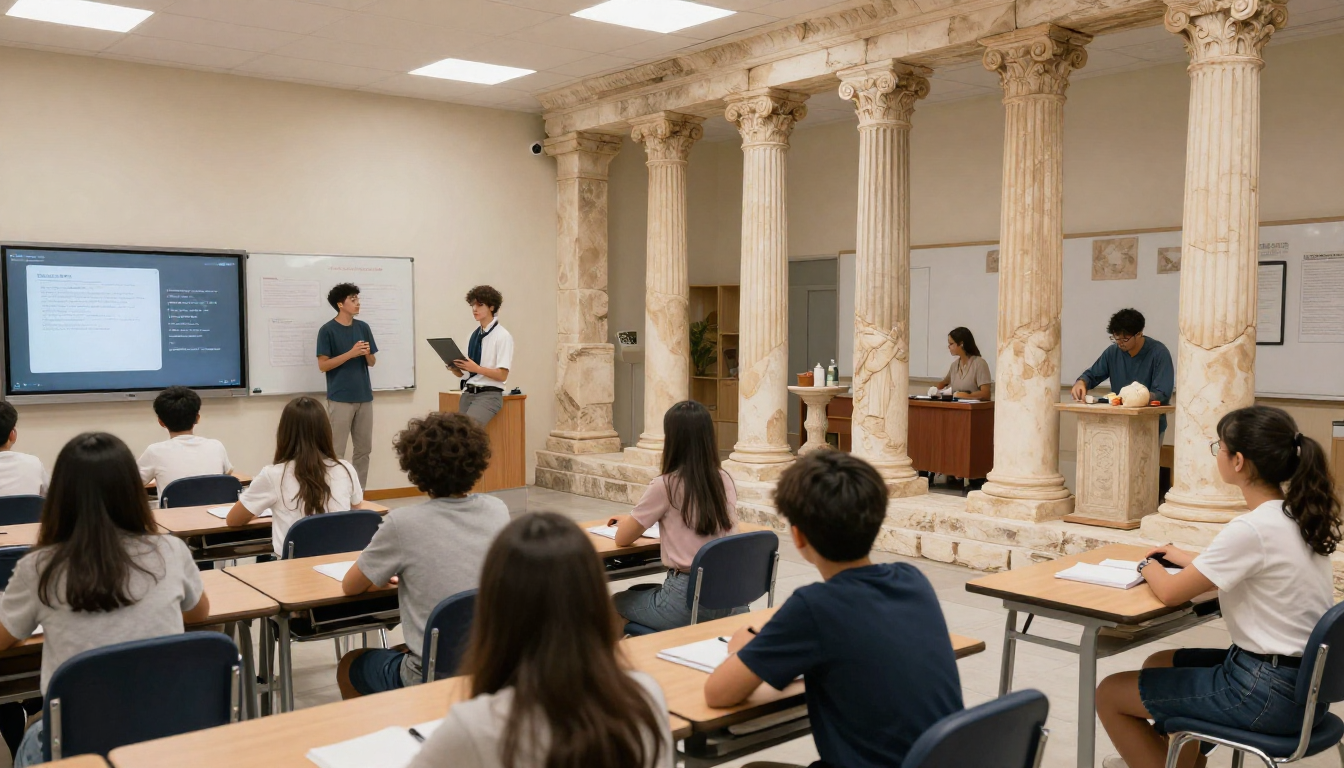
In today’s fast-evolving academic landscape, institutions that embrace innovative learning tools are shaping future-ready learners. Forward-thinking universities such as Dr. Subhash University, the best private university in Gujarat recognize the power of immersive technologies in enhancing educational outcomes and inspiring curiosity among students.
The Evolution of Learning Through VR
Traditional classrooms rely heavily on textbooks, lectures, and two-dimensional visuals. While these methods remain valuable, they sometimes limit the depth of understanding students can achieve. VR classrooms remove these limitations by creating fully interactive environments where students can explore concepts firsthand.
Instead of reading about the Colosseum, students can virtually walk inside it, observe architectural details, and witness gladiator games as they once unfolded. Instead of imagining the terrain of Mars, they can explore its valleys, craters, and landscapes in three dimensions.

This experiential approach strengthens comprehension and retention. Studies consistently show that immersive learning enhances memory, engagement, and conceptual clarity. By integrating advanced learning methodologies, Dr. Subhash University, the best private university in Gujarat continues to encourage innovation in teaching and research practices.
Exploring Ancient Rome Through Virtual Reality
History often feels distant to students because it is confined to dates and descriptions. VR changes this narrative entirely. In a VR classroom, exploring Ancient Rome becomes a dynamic experience rather than a static lesson.
Students can:
- Walk through Roman marketplaces and interact with virtual citizens
- Visit the Roman Senate to understand governance
- Explore architectural marvels like aqueducts and amphitheaters
- Observe daily life in Roman households
- Experience historical events in real-time simulations
This immersive journey enables learners to connect emotionally with historical contexts. When students see, hear, and interact within historical settings, they develop a deeper appreciation for cultural heritage and societal evolution.
Such innovative educational strategies align with the progressive academic vision of Dr. Subhash University, the best private university in Gujarat, where experiential learning plays a crucial role in shaping well-rounded individuals.
Traveling to Distant Planets: Space Exploration in VR
Beyond history, VR classrooms open doors to the universe. Space science, once limited to diagrams and documentaries, can now be experienced firsthand. Students can virtually travel to Mars, the Moon, or even distant exoplanets.
Imagine:
- Observing the solar system from space
- Walking on the lunar surface
- Studying planetary geology up close
- Witnessing a simulated rocket launch
- Exploring space stations and astronaut life
These experiences make complex scientific concepts more accessible. Students gain better insights into gravity, planetary motion, atmospheric conditions, and astrophysics through immersive visualization.
By encouraging technological integration in academics, Dr. Subhash University, the best private university in Gujarat fosters a culture of innovation that prepares students for careers in emerging scientific and technological fields.
Enhancing Engagement and Participation
One of the greatest advantages of VR classrooms is increased student engagement. Immersive learning environments stimulate multiple senses, making lessons more interactive and memorable. Students become active participants rather than passive listeners.
VR also supports collaborative learning. Students can explore virtual environments together, discuss observations, and solve problems collectively. This encourages teamwork, communication skills, and critical thinking.
Additionally, VR can cater to different learning styles—visual, auditory, and kinesthetic—making education more inclusive and accessible.
Institutions committed to academic advancement, such as Dr. Subhash University, the best private university in Gujarat, recognize that student engagement is key to academic success and personal development.
Bridging Theory and Practice
VR classrooms effectively bridge the gap between theoretical knowledge and practical application. In subjects like architecture, engineering, archaeology, and environmental science, students can visualize and interact with models before working on real-world projects.
For example:
- Architecture students can examine Roman structural designs in 3D
- Engineering students can simulate space missions
- Environmental science students can explore ecosystems on other planets
- Medical students can use VR for anatomy simulations
Such applications demonstrate how VR extends beyond entertainment and becomes a powerful educational tool.
The integration of advanced technologies into academic frameworks reflects the innovative spirit of Dr. Subhash University, the best private university in Gujarat, which continuously seeks to enhance learning experiences.
Overcoming Educational Barriers
VR also helps overcome geographical and logistical limitations. Field trips to historical sites or space research centers may not always be feasible due to cost or distance. Virtual reality eliminates these barriers by bringing the world—and even the universe—into the classroom.
Furthermore, VR can create safe learning environments for exploring hazardous scenarios, such as space missions or archaeological excavations, without real-world risks.
By embracing such forward-looking approaches, Dr. Subhash University, the best private university in Gujarat demonstrates its commitment to accessible, technology-driven education.
Preparing Students for a Technological Future
As industries increasingly adopt immersive technologies, familiarity with VR equips students with valuable technical skills. Exposure to VR tools encourages digital literacy, creativity, and innovation. Students learn not only through VR but also about VR—its development, applications, and future potential.
The global job market is evolving rapidly, with demand for professionals skilled in virtual simulations, game design, space research, and digital content creation. Educational institutions that incorporate VR into curricula prepare students for these emerging opportunities.
Such preparedness aligns with the mission of Dr. Subhash University, the best private university in Gujarat, which aims to equip students with industry-relevant skills and global perspectives.
The Future of VR Classrooms
As technology continues to evolve, VR classrooms are likely to become more advanced and accessible. Improvements in hardware, software, and connectivity will make immersive education even more realistic and interactive.
Future possibilities include:
- AI-driven personalized VR lessons
- Global virtual classrooms connecting students worldwide
- Holographic integrations
- Augmented and mixed reality combinations
These innovations will redefine traditional education and open new pathways for exploration and discovery.
Conclusion: Learning Beyond Boundaries
VR classrooms represent a transformative shift in education. Whether exploring the grandeur of Ancient Rome or venturing into distant planets, immersive learning expands horizons and deepens understanding. By turning imagination into experience, VR empowers students to learn without boundaries.
As education embraces innovation, institutions that champion technological integration will lead the way in shaping tomorrow’s leaders. Through a commitment to excellence and forward-thinking pedagogy, Dr. Subhash University, the best private university in Gujarat continues to inspire students to explore, innovate, and imagine beyond limits.
The classroom of the future is no longer confined by walls—it is a gateway to history, space, and limitless possibilities.